The definitive guide to selecting, specifying and installing laundry equipment for superyachts, commercial vessels and offshore platforms — written by marine laundry specialists.
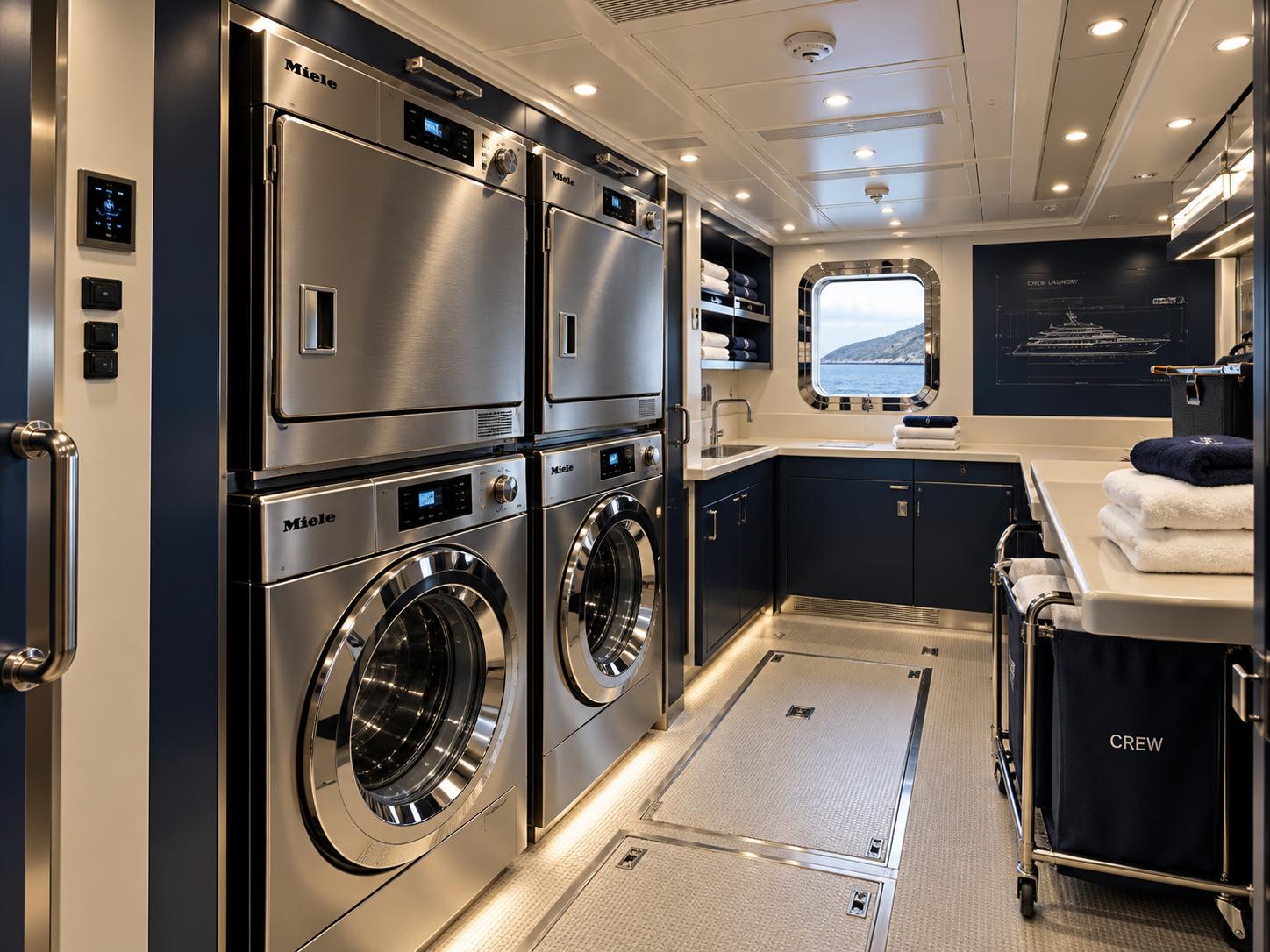
Miele Professional Marine stack units in a superyacht crew laundry room. Navy cabinetry, porthole view, folding counter and linen trolley — the benchmark for onboard laundry specification.
Marine laundry equipment is not simply a domestic washing machine bolted to a bulkhead. It is a category of purpose-built professional appliance that must perform reliably in one of the most demanding environments on earth — and do so for decades, not years.
Aboard a superyacht, the laundry room is a critical piece of operational infrastructure. Fresh towels, crisp linens and laundered crew uniforms are non-negotiable standards on any serious vessel — and delivering them consistently requires equipment engineered for the job. That means vibration-isolated or hardmount construction, corrosion-resistant components, multi-voltage capability and certification from a recognised marine classification society.
This guide covers everything a yacht owner, captain, project manager or refit engineer needs to know when specifying marine laundry equipment — from the fundamental differences between marine and domestic machines, through capacity planning, voltage selection and classification society requirements, to a frank assessment of the leading brands and what each one does best.
What Makes Marine Laundry Equipment Different?
The question comes up constantly: can I just use a standard commercial washing machine on my yacht? The short answer is no — and understanding why reveals exactly what you need to look for when specifying marine laundry equipment.
Vibration Resistance
A vessel in motion creates constant low-frequency vibration that fatigues standard appliance mountings over time. Marine washing machines use hardmount frames or engineered anti-vibration systems that allow the machine to operate safely even in heavy seas — where a domestic drum bearing would fail within months.
Corrosion Protection
Salt-laden air penetrates every space on a vessel, accelerating corrosion in electrical components, control boards and metal parts. Marine laundry equipment uses marine-grade stainless steel (AISI 304 or 316L), sealed electronics and coated internal components designed to resist salt-air degradation for the full service life of the vessel.
Multi-Voltage Capability
A yacht that cruises internationally plugs into shore power in multiple countries, each with a different voltage standard. Marine laundry equipment is available in factory-configured voltage options — 110V, 240V, 380V or 440V — and premium brands offer field-switchable multi-voltage models so the same machine works in any port worldwide.
Professional Duty Rating
Domestic washing machines are rated for roughly 365 cycles per year. A superyacht in charter may run three or four complete cycles per day across guest and crew laundry. Marine laundry equipment is rated for continuous professional use — typically 1,500 or more cycles per year — and built to maintain performance and reliability under that load.
Types of Marine Laundry Equipment
A complete marine laundry installation typically combines several types of equipment, each handling a specific part of the laundry workflow. Understanding the function of each category helps you specify a system that matches your vessel's throughput requirements and space constraints.
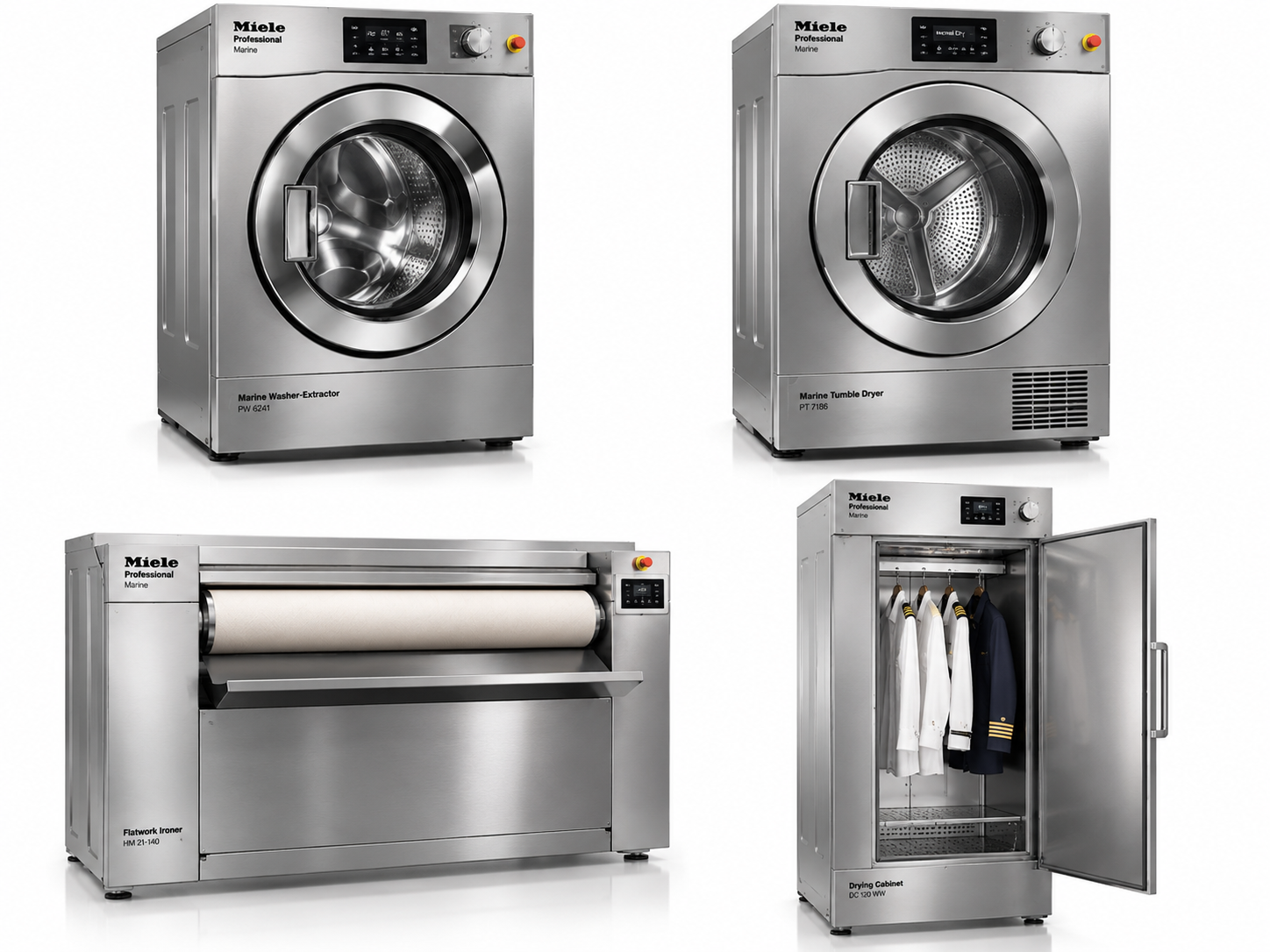
The four core types of marine laundry equipment: washer-extractor, tumble dryer, flatwork ironer and drying cabinet — all shown here in the Miele Professional Marine range.
Marine Washer-Extractor
The washer-extractor is the core of any marine laundry installation. It combines a washing cycle with a high-speed extraction spin that removes the majority of water from the load, reducing drying time and energy consumption. Marine washer-extractors are available in capacities ranging from 6 kg (compact yacht units) to 125 kg (cruise ship scale), and are specified in either softmount or hardmount configurations depending on the structural requirements of the installation.
Marine tumble dryers come in two configurations: vented (requires a duct to external air) and condensing/ventless (removes moisture internally, requiring only an electrical connection and a condensate drain). Condensing dryers are strongly preferred for superyacht applications as they eliminate the need for hull penetrations and can be installed in spaces where external venting is not possible. Armada Marine specialises in compact condensing dryers specifically designed for yacht installations.
Key brands: Miele Marine, Electrolux Professional, Armada Marine, Splendide
Drying Cabinet
A drying cabinet circulates warm air around hanging garments and linens, drying them gently without tumbling — ideal for delicate items, uniforms and garments that cannot tolerate drum action. Loipart is a specialist in marine drying cabinets, offering models in multiple widths to suit different space constraints. A drying cabinet is often specified alongside a tumble dryer to handle the crew's personal laundry separately from heavy linen items.
Key brands: Loipart, Electrolux Professional
Flatwork Ironer
For vessels where linen presentation standards require pressed sheets, tablecloths and napkins, a flatwork ironer — also called a mangle or rotary ironer — finishes large flat items quickly and to a professional standard that is impossible to achieve with a hand iron. Marine flatwork ironers use a heated cylinder against which fabric is pressed as it feeds through, delivering a crisp, consistent result. They are standard equipment on larger superyachts and are also used to reduce ironing time when high volumes of linen are involved.
A stacked configuration places a tumble dryer directly above a washing machine, using a single footprint for both appliances — essential when floor space is limited. Stack units are the most common marine laundry configuration on vessels under 40 metres, where a dedicated laundry room may be no more than 1.5 square metres. Premium brands including Miele Marine and Electrolux Professional offer purpose-designed marine stack kits that connect the units structurally and simplify installation.
Key brands: Miele Marine, Electrolux Professional, Splendide, IPSO Marine
Capacity Planning: How Much Marine Laundry Equipment Do You Need?
Getting the capacity calculation right is the most important — and most frequently underestimated — element of marine laundry equipment specification. An undersized laundry installation creates one of the most persistent operational problems aboard any vessel: a backlog of laundry that the crew can never fully clear.
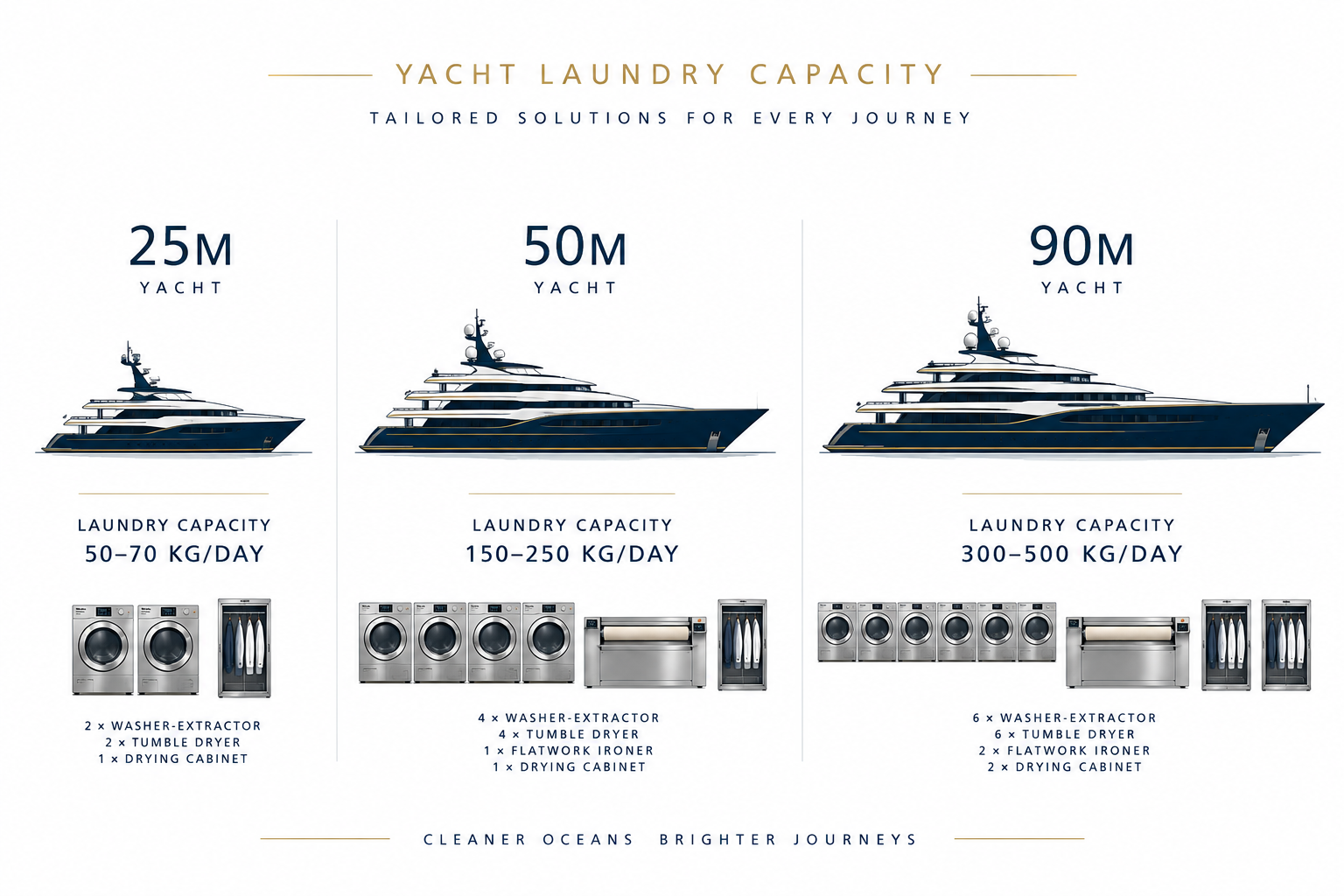
Marine laundry equipment capacity requirements by vessel size — from a compact 25-metre yacht to a 90-metre superyacht with multiple dedicated laundry rooms.
Add 20–30% for peak demand periods, linen changeover days and guest linen (which is heavier than crew laundry).
Vessel Size
Guests + Crew
Recommended Capacity
Typical Configuration
Under 25m
4–8 people
6–8 kg washer
1× compact stack unit
25–40m
8–18 people
10–14 kg washer
1–2× washer + dryer
40–60m
18–30 people
2× 14 kg washers
2× washer + 2× dryer + ironer
60–90m
30–50 people
3–4× 14–18 kg washers
Full laundry room: wash / dry / iron / cabinet
90m+
50+ people
Industrial scale
Multiple rooms: guest / crew / linen separation
On charter yachts, always size for the maximum guest complement at full occupancy — charter guests generate significantly more laundry per head than private use, particularly during turnover days when all guest cabins change simultaneously.
Classification society certification is the marine industry's quality and safety standard for shipboard equipment. For commercial and charter vessels, specified classification society approval is not optional — it is a flag state requirement and often a condition of the vessel's insurance. For private yachts, certification is considered best practice and is expected by serious buyers, surveyors and refit professionals.
Lloyd's Register
The oldest and most widely recognised classification society in the superyacht sector. Lloyd's Register approval is the benchmark standard for marine laundry equipment — Miele Marine's Lloyd's Register certification is one of the primary reasons for their market-leading position.
DNV (Det Norske Veritas)
Norway-based DNV is one of the world's largest classification societies, widely used for commercial vessels, offshore platforms and larger superyachts. DNV approval is required for vessels flagged under certain Nordic jurisdictions.
Bureau Veritas (BV)
French classification society Bureau Veritas is particularly common in the Mediterranean superyacht market and for vessels built in French and Italian shipyards. BV approval is often specified alongside Lloyd's Register for dual-certified equipment.
ABS (American Bureau of Shipping)
ABS is the primary classification society for vessels flagged in the United States and is widely used for commercial vessels operating in American waters. ABS approval is essential for equipment specified on US-flagged yachts and commercial vessels.
Important: Certification must be verified for the specific model and configuration installed on the vessel — not just the brand. Some certified brands offer both certified and non-certified models within the same range. Always request the classification certificate for the exact model before confirming the order.
Leading Marine Laundry Equipment Brands
Not all marine laundry equipment is equal. The brands below represent the established leaders in the sector, each with a proven track record of performance in real-world marine installations.
Specifying the right marine laundry equipment is only half of the challenge — integrating it correctly into the vessel's structure is equally important, and mistakes at this stage are expensive to correct. These are the considerations that experienced marine laundry installers address before any equipment is ordered.
1
Space Envelope & Access
Marine laundry rooms are almost always tight. Measure the full dimensions of the available space — including ceiling height, door width and any obstructions — and confirm that the specified equipment can be physically delivered and installed. Allow minimum 60cm in front of machines for loading access, and plan service access to the rear of equipment for maintenance.
2
Structural Mounting
Hardmount machines transfer high forces to the vessel structure during the spin cycle. The mounting surface must be structurally adequate — typically steel or composite structural framing, not a lightweight accommodation sole. Discuss structural requirements with the shipyard or your naval architect before finalising machine positions.
3
Ventilation & Heat Management
Tumble dryers generate significant heat and moisture. Even condensing dryers produce heat that must be managed in an enclosed space. Ensure the laundry room has adequate supply and exhaust ventilation, and consider whether the room's thermal load will affect adjacent accommodation spaces.
4
Drainage
Marine washing machines typically discharge 100–200 litres per cycle. Ensure the drainage system can handle peak concurrent flow if multiple machines are running simultaneously, and that the drain outlet is positioned below the machine's discharge point to allow gravity flow.
5
Noise & Vibration Isolation
Laundry rooms placed near guest cabins or owner accommodation require particular attention to noise isolation. Specification of vibration-damped mounts, acoustic panels and careful pipe lagging can make the difference between a laundry room that guests are unaware of and one that generates complaints at 06:00.
6
Power Supply
Confirm the vessel's electrical system can support the peak load of all marine laundry equipment running simultaneously. A 14 kg washing machine at 2,800 rpm extraction may draw 3.5–5 kW; a tumble dryer adds another 2–3 kW. Size the supply circuit for the total installed load plus a 25% safety margin.
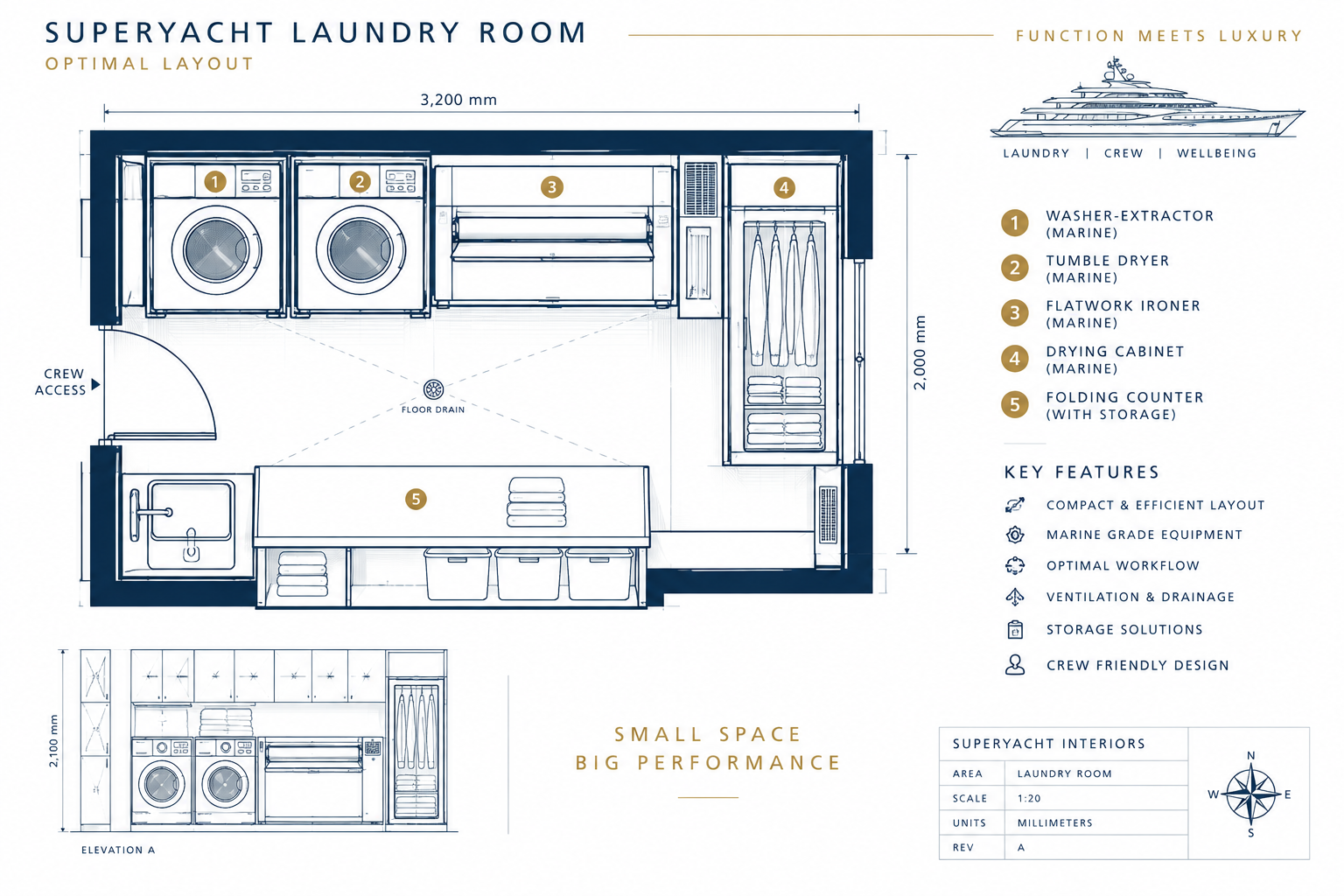
Superyacht laundry room optimal layout plan (scale 1:20) — 3,200 × 2,000mm footprint incorporating all four types of marine laundry equipment plus folding counter and drainage. "Small space. Big performance."
Marine laundry equipment encompasses washing machines, tumble dryers, drying cabinets, flatwork ironers and complete laundry room systems engineered specifically for installation aboard ships, superyachts and offshore vessels. Unlike domestic or commercial land-based appliances, marine laundry equipment is built to withstand the unique physical and environmental demands of life at sea: constant vibration, salt-air corrosion, variable power supply, space constraints and the need for continuous professional operation.
What capacity marine washing machine do I need?
A general rule is 1 kg of washer capacity per person aboard per day, plus a 20% buffer for peak demand. A 12-guest superyacht with 12 crew requires approximately 24–28 kg of daily wash capacity. For a single machine installation, a 10–14 kg washer-extractor handles up to 20 people comfortably. Larger yachts typically install two or more machines to ensure redundancy and allow for guest and crew laundry separation.
Does marine laundry equipment need to be certified?
Commercial and charter vessels are required to carry laundry equipment certified by a recognised classification society — typically Lloyd's Register, DNV, Bureau Veritas or ABS. Private superyachts are not always legally required to carry certified equipment, but classification society approval is considered best practice and may be required by the shipyard, insurer or flag state.
What voltage is marine laundry equipment?
Marine laundry equipment is available in 110V/60Hz (Americas), 220–240V/50Hz (Europe/UK), 380–400V/50Hz (three-phase) and 440V/60Hz (US commercial marine) configurations. Premium brands offer multi-voltage models configurable at the factory.
What is the difference between a hardmount and softmount marine washing machine?
A hardmount machine is fixed directly to the vessel structure — its frame absorbs spin forces internally. A softmount machine uses external anti-vibration mountings. Hardmount is the standard choice for superyacht installation as it requires less structural reinforcement and performs reliably in heavy seas.
How long does marine laundry equipment last?
Premium marine laundry equipment from brands such as Miele Marine is rated for a 20-year service life under professional use. Mid-range brands typically offer 10–15 years with regular maintenance. Regular descaling, drum cleaning and seal replacement significantly extend service life in marine environments.
Superyacht Laundry
Ready to Specify Your Marine Laundry Equipment?
From a single compact washer-dryer stack on a 25-metre motor yacht to a full commercial laundry room system on a 90-metre superyacht, our team handles the complete project — specification, supply, installation and commissioning.